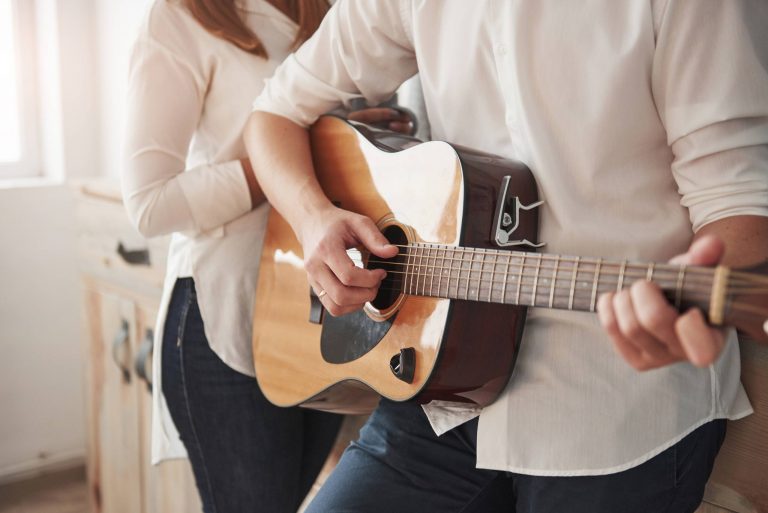
Finger Independence Exercises A huge part of improving your guitar playing skills is developing finger independence. This is the ability to control each of your fingers separately. One of the best ways to do this is to practice fingerpicking. I will go into detail about fingerpicking in the next chapter, but for now, here is a good finger independence exercise: Place your hand in a relaxed position over the fretboard. Now, take your thumb and place it on the back of the neck for support.
One of the biggest breakthroughs you can have as a guitar player is to learn how to have your fingers do their own thing in terms of the strength and movement of each finger, and the control of the other fingers. Anytime you try to do anything that involves one finger playing a note, while the other fingers are keeping one down, you probably feel the other fingers want to move with it. It could be something as simple as changing from one chord to the next, or playing a simple melody where you have to stay on one note while the other finger plays another note.
My go-to is holding 3 fingers down on a string while doing the hammer-on/hammer-off action with the 4th finger. This will get the little finger strong without having to use the others. I will play variations that allow a finger to play freely while the others stay on the string to allow my brain to isolate that finger, thus losing the extraneous movement. I practice slowly with a metronome, then faster and focus on remaining relaxed, not allowing tension in the hand. Within months you will be able to do what you couldn’t do before, leading to smoother chord changes and smoother single note runs.
Doing these independence exercises as part of a daily warm-up routine makes them feel less like a chore and more like a benchmark where you notice consistent progress. Using them in a musical context, like shaping a chord but playing the strings one at a time, ties them to playing, and results can be seen and heard right away in the form of smoother chord changes and cleaner lead lines. It’s easy to see how the work pays off. Eventually, playing an instrument begins to feel less like a physical chore and more like a dialogue between your hands.
Just as important is your mental approach. One of the more frustrating experiences can be when, after weeks of regular practice, you don’t feel like you’ve made any progress. If you record yourself for a few minutes every week or so, you can go back and listen to yourself and hear the progress you’ve made even when you can’t feel it. And be sure to recognize small accomplishments, like getting a hammer-on with your pinky that doesn’t sound like you just dropped a brick on your guitar, or being able to apply even pressure while changing positions with your ring finger. Remember that finger independence comes from time, not from pushing your fingers to learn how to be independent.
Outside of this specific exercise, finger independence unlocks many techniques that allow for more complex playing and musical expression. When your fingers can respond and play independently, it makes barre chords, fingerstyle, and bends easier to learn and play. It also allows you to form a stronger bond with your instrument. Regular practice of the above exercises will make you feel that the new techniques you are learning on the guitar are much easier.